
Residents and activists continue to fight for rights of Jai Bhim Nagar residents despite several legal and administrative hurdles.
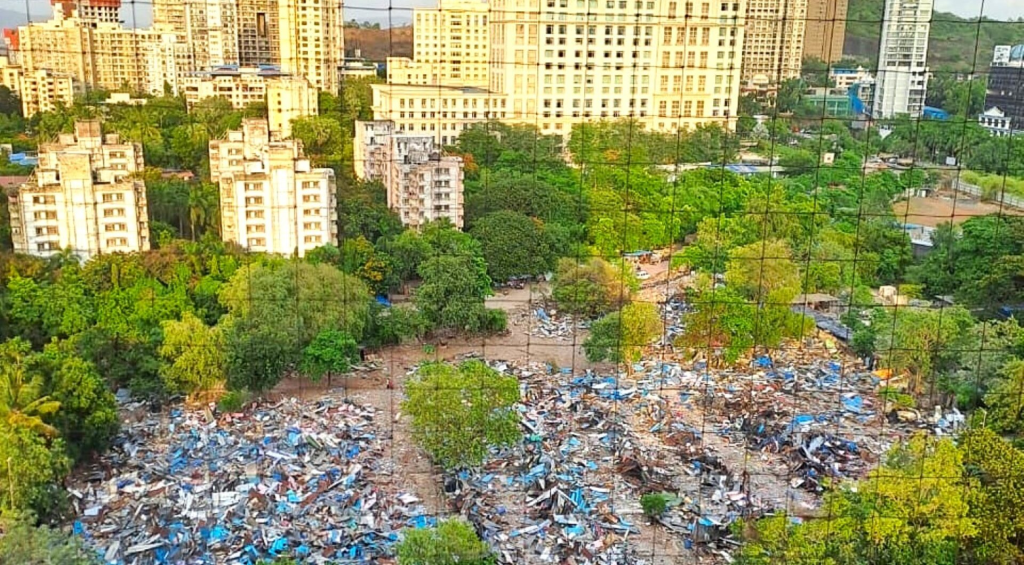
The Jai Bhim Nagar basti, located at the heart of Powai’s posh Hiranandani Gardens, was demolished by the BMC on June 6 2024. Residents claimed that they were given barely any notice before the demolition. Not only did this contravene a state law prohibiting demolitions during monsoon months, but several locals also claimed to have identification validating their residency in the area.
Since then, they have been living on the roads around the demolished settlements, braving the rains. 28 residents, most of them from scheduled castes, have also filed a petition against the demolition, requesting a Special investigation team (SIT) be constituted for this.
Most recently, based on a report by the SIT, an FIR was filed against BMC authorities, developer Hiranandani, and other associates for using fraudulent methods to demolish the settlement in the monsoon. The High Court has instructed the SIT to file a status report of the case by November 18th.
On the demolition of the Jai Bhim Nagar settlements in Powai and delved into the legally dubious history of Hiranandani Gardens where they stood. On October 5th, the Powai police filed a FIR against officials of BMC’s S ward, Hiranandani Group (HGP Community Pvt Ltd), and four associates on the recommendation of the Bombay High Court for conducting unauthorised demolitions in Jai Bhim Nagar. The charges against the accused include criminal conspiracy, public servant framing an incorrect document with intent to cause injury, and furnishing false information among others.
About 100-150 families remain of the 600-650 that lived in Jai Bhim Nagar before the demolition. The ones who have stayed back, braving intense spells of rain in the last few months, have alleged instances of intimidation and surveillance from private bouncers as well as the police.
Why is moving not an option?
About six months before the demolition, residents of the settlement said they were offered to be moved to another settlement near Vikhroli called Mahatma Phule Nagar, by the Hiranandani Group. There was strong resistance against this because the neighbourhood is remote, and several kilometres away from where most locals work as househelp or service providers.
Moreover, the area is not developed, and is feared to be unsafe, especially for women. “We have young girls in our families, there are bad men there, Pushpatai, one of the residents, told Freedom of Speech.
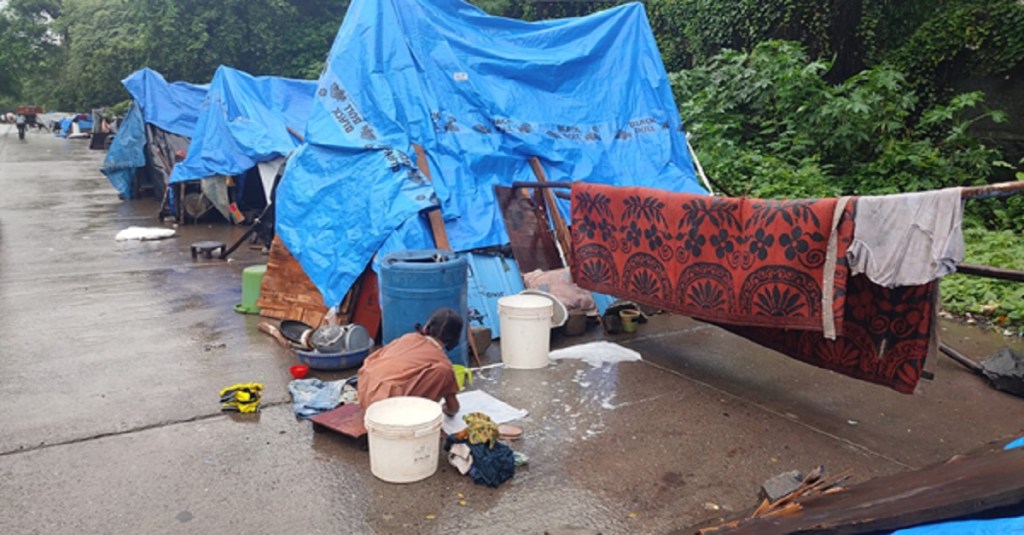
Locals also have apprehensions because the Phule Nagar land’s ownership is disputed. “We don’t want to go to Mahatma Phule Nagar, because again they would let us be there only for six months and evict us any day like this. Then we would be neither here nor there,” Savitribai said.
Land activists have raised questions about the legality of such a rehabilitation offer as well. “There is no scheme or law which allows people of one slum to shift to another slum. Are they willing to give the residents ownership of the land, or is this an attempt to create another slum in Phule Nagar?” asks Shubham Kothari, a land activist with Jan Haq Sangharsh Samiti.
Rehabilitate us near Jai Bhim Nagar: Residents’ petition
Jai Bhim Nagar locals want to be allotted housing near their now-demolished settlement itself. The petition filed by community members in the High Court states that residents have legal and valid documents such as Aadhaar cards, voter IDs, electricity bills, bank passbook, domiciled certificates and other authenticated documents to demonstrate that they have been residing there for about 30 years.
The petition also states that residents acquired the right to occupy and reside in the settlement on private land over 30 years ago. The structures built with permission from the BMC later became permanent. In view of this, “it was obligatory on the part of the corporation and even a builder to take recourse [to] legal remedy…they could have been dishoused and removed and evicted from the disputed premises after due process of law not otherwise,” the petition says.
While residents can contest the illegal demolition based on a fraudulent complaint in the SHRC, their right to housing in Jai Bhim Nagar or a nearby area in Powai is murkier.
What rights do the residents have?
Under the Maharashtra Slum Areas (Improvement, Clearance And Redevelopment) Act, 1971, slum dwellers in a ‘declared’ slum can apply for right to tenure of the land. If 75-90% of slum dwellers apply, the government can acquire the land and hand it over to a constituted cooperative housing society. This, however, only applies to government-owned land or land acquired by the government, and not privately owned land like Jai Bhim Nagar.
Electricity and water were provided by the developer, and not civic authorities, further reducing their claim to schemes made for slum dwellers.
Residents of a declared slum can avail of Slum Rehabilitation Authority (SRA) schemes, including rehabilitation. However, Jai Bhim Nagar is not a declared slum yet. For this, “the state has to first engage in the exercise of identifying protected occupiers through a survey prior to demolition,” Kothari said. No such survey has been carried out in Jai Bhim Nagar. In light of this, it is unclear how the residents would be rehabilitated.
 Cinpra Free Souls Foundation